Dumbest. Patient. Ever. And what we can learn from him.

He had high blood pressure, diabetes and smoked a pack of cigarettes a day. He didn't want to take additional medications, did not want to change his diet and definitely did not want to stop smoking, yet there he was in my office, presenting for medical care. He had no interest in changing any behaviors but said he wanted to be healthy! What could I do? What could I say?

cutcaster-801178012-Curly-For-President-small.jpg

I did my best to reason with him. I explained the effects of high blood pressure, diabetes and smoking on the body. He wasn't interested. I changed my approach, bargaining with him at each visit trying to get him to do a little more to improve his health. I focused on his blood pressure first as this was where he seemed to be least resistant. As this came under better control I turned my attention again to his diabetes, only to run into a brick wall of resistance. He had no desire to change. He was going to eat what he wanted when he wanted.
Frustrated, I resigned myself to a long process. He failed to follow up for his scheduled appointments, only coming in when I refused to refill his blood pressure medications. Each time he did come in I addressed his diabetes and his smoking. Between visits the office sent reminders and made phone calls, encouraging him to address his health. After several months of this he decided enough was enough. He had his wife call the office and leave me a stern message, "Bill says that if you talk to him anymore about his smoking and eating he will find another doctor!"

I was taken aback at his words. It was as if he was saying, "You can be my doctor as long as you don't act like a doctor!" It was the most absurd message I had ever received. My reply was simple, "He will need to find another doctor."

It is easy to say that Bill was strange, that refusing to listen to someone with medical knowledge, wisdom and expertise, someone who had his best interests at heart, is something we would never do. It is easy to think that we are better and smarter. It is easy, but I think it is wrong. We are all like Bill at times, we just aren't as obvious!

Don't think so? Physically, relationally and spiritually we all have a tendency to trust ourselves more than concerned others who have our best interests at heart. Think about it-

Physically- We struggle with obesity, watch too much TV, don't exercise enough, drink too much, and engage in so many other self-destructive behaviors. We know it is bad, but we do it. Why?
Relationally- We are selfish, don't spend enough time with our family, watch too much TV, and hold onto grudges and anger, even when we know better. Why?
Spiritually- is perhaps where we are most like Bill. We want to make our own rules, pick and choose which sins to hang on to and which ones to put aside. We don't want God to tell us what to do and we even want to decide for ourselves what God is like! We ignore the truth that God knows best and that the only wise response is to simply do what He tells us. Why? Because we are broken people who need to change!

We are all like Bill, but we can choose to be different. Let's start the same way I started with Bill. Let's pick one area where we know we need to do better, and let's do better. Start with something easy if we need to, but start. Most importantly, let's make a promise to ourselves to never stop!

A Dying Man, a Hopeless Situation and a Prayer

cutcaster-902501173-Medical-monitor-and-IV-drips-small.jpg

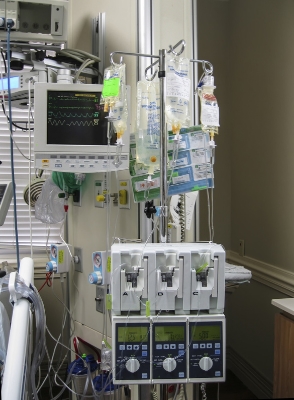
He was dying. He was receiving the very best medical care in an outstanding hospital, yet he was dying. Days earlier he had been vibrant, active and healthy. His only medical problems had been high blood pressure and diabetes, both of which were well controlled with medications. Now he was hooked up to a ventilator, unable to breathe on his own, his lungs stiff from infection and inflammation. His heart was failing, unable to beat hard and fast enough to sustain his blood pressure and supply his vital organs. Multiple IV lines poured medications and fluids into his veins in what seemed to be a futile attempt to keep him alive. His bed was tilted with the head down to divert blood flow to the brain  in the hope that if he somehow survived he would not suffer permanent brain damage.

He was under the care of lung specialists, heart specialists, infectious disease specialists, every specialist I could think of, and yet, he was dying. We had run out of ideas. We had done all we could, and it was not enough. I felt defeated and hopeless as I went to inform his family.

I walked out to the waiting room to break the news, wanting to prepare them for the sadness that was to come and allow them to say their good-byes. Tears flowed from multiple eyes as I described the situation.

"Is there anything else we can do?," his wife asked.

"We are doing everything we can," I replied.

And then I realized there was one more thing I could do. I asked, "Would it be okay if I prayed with you?"

"Certainly!" she replied.

So I prayed. I do not remember the exact words I used, but I do remember admitting that I did not know what else to do and asking God to make him better.

To my surprise, God did. For reasons no one could explain, he got better. The infection disappeared, his lung stiffness went away and his heart began to do its job. His blood pressure climbed back to normal. Within just a few days he was breathing on his own. He was alert and talking and in full possession of his faculties. To my further amazement, when he left the hospital a few days later he no longer needed diabetic or blood pressure medicines!

I learned some important lessons that day. I learned that it is okay to admit that you do not know what to do. It is okay to tell the truth, and it is okay to ask permission to pray, even when you do not know if the family has faith.

It is also okay to ask for a miracle, because every once in a while, you get one!

Demanding Respect Doesn't Work and 5 ways Respect can be Earned

Have a hard time dealing with condescension and disrespect?  How we respond to negative treatment says a lot about us and our insecurities, a lesson I have learned the hard way.

cutcaster-902879736-Guy-Shows-Loser-Signal-With-His-Fingers-small.jpg

I have respect issues. Nothing pushes my buttons like condescension and dismissal. Disrespect and ridicule are a common part of medical training and I did not handle it very well. Disrespect is particularly common in surgeons. I did not appreciate their arrogance and made it a point to defend myself. One interaction I had with a rude gynecologic oncologist became well known throughout my med school class.
In my third year at UCI (University of California Irvine) Medical School I was assigned to be the "second assistant" for a hysterectomy, which means I was given the privilege of standing by the patient's feet while the surgeon and OB-Gyn resident performed the surgery. Like a 4 year-old child at a dinner party, second assistants are to be seen and not heard. Nothing was said to me for the 90 minute procedure. Nothing. No instruction, no description of the procedure, no background on the patient's history, not a word until the case was wrapping up, at which time the attending looked over at me and asked, "So Bart, where did you get your undergraduate degree?"
"UCI," I replied, surprised to be noticed.
"Oh, another f----ing Irvine-Irvine student. Like we need another one of those!"
My anti-disrespect mechanism kicked in immediately. Game on.
"Where did you go to medical school?" I asked innocently.
"I went to UC Davis," he responded with pride.
"I applied to Davis," I said, "but I did not get in." Pause for effect, then- "They told me I wasn't dumb enough."
End of conversation. Game over.
As we left the operating room the resident called me aside, "You can't do that!"
I was firm in my response, "I didn't start it, but I finished it!" I did pay a small price for my attitude, if for my grade in that clinical rotation I would have gotten straight A's that year. My inability to tolerate disrespect cost me.
I can say from experience that a young person desiring respect will find that a chip on the shoulder and a biting wit do not bring the desired result.
So how can a young person gain respect? How does one establish themselves as a person of value, someone who can lead and be admired? The Apostle Paul gave his young protege Timothy valuable counsel in this regard, 2000 year old advice that still resonates to day.
1 Timothy 4:12 "Don't let anyone look down on you because you are young, but set an example for the believers in speech, in conduct, in love, in faith and in purity."
Paul gave 5 ways that Timothy could demonstrate maturity and leadership-
Speech- watch what you say and how you say it. Mature people know when to speak and when not to, what to say and when to say it.
Conduct- mature people act with maturity. They control their temper and act responsibly.
Love- Mature people put others before themselves and are characterized by kindness and service.
Faith- I have seen that a life lived based on genuine faith is an admirable one. When your life is consistent with your values people notice.
Purity- So many young people bounce from one sexual relationship to the next. Those that pursue purity set themselves apart.

Hmmm. I need to follow this advice! While my quick tempered tongue can silence a critic, it is the quality of my life that gains me respect! 

Dumped, Depressed and Discouraged? There is hope.

I got dumped on my 19th Birthday. I was devastated. Normally that would have been a good time to go to the leader of our college ministry for help and advice. I say normally because the week before the leader abruptly stepped down because of problems in his marriage. The Bible Study group had been the center of my life for 2 years, meeting twice a week. In a matter of just a few days I had no girlfriend, no college group and it seemed no hope. I didn't have much money as I only had a part-time job and I didn't have much of a future as I was not in college. As I looked at my life there was very little to feel good about. I was so depressed that every area of my life suffered. I am amazed I didn't lose my job as my performance was terrible. I was deeply discouraged and yet out of that experience came a lesson that has endured for the remainder of my life.

cutcaster-100918308-Horizontal-dumpsters-large.jpg

One day I was praying, explaining to God how miserable my life was (as if he did not already know!). As I prayed a question came to my mind, “Which one of these life events has taken Jesus down from his position in heaven and stuck Him back in the tomb?”

“None of them,” I answered myself.

Another question came to mind, “So what is your problem?”

In that moment I learned the most important way to deal with discouragement, the way emphasized by the writer of Hebrews 12. The most important way to avoid discouragement is to maintain a proper focus. The writer of Hebrews instructs us to “Fix our eye on Jesus, the author and perfecter of our Faith, who, for the joy set before him endured the cross, despising the shame and sat down at the right hand of God.”

He tells us we are to look to Jesus, who:

  • is the basis, the beginning, source and fulfillment of our faith.

  • Models for us how to endure difficult times. Jesus did not focus on the sufferings of this life but instead of the eternal joy that lay ahead. He was able to go to the cross because He saw through the cross. By focusing on the eternal He was able to endure earthly suffering and rejection.

  • Won an eternal victory. After the cross and resurrection, Jesus “sat down” at the right hand of God. His work was complete and the victory was sure.

I realized that my discouragement was in large part because when I looked at my life I was focusing on the wrong thing. This life is difficult, but this life is not all there is. Eternal life awaits those who trust in God. It will eventually get better. The glorious hope that belongs to those of faith is a powerful antidote to discouragement.

The antidote does not always work immediately, like antibiotics for an infection we may need to take the medicine for several days before it takes effect. But it does work!

This is the fifth post of a series on Dealing with Discouragement. If you have been touched by these posts, please share them with a friend. If you would like to subscribe to this blog and receive future posts by email, click on the subscribe link. Beneath my photo upper right on a computer screen or scroll to the bottom on your mobile device.

Weary and Discouraged? Maybe You're a Jerk Like me!

cutcaster-902476132-Marathon-small.jpg

When things don't go as we want or plan discouragement can quickly follow. It is easy to think that if we could change our circumstances our discouragement would go away. Unfortunately, changing our circumstances often requires that we change ourselves.

I want to be a great doctor. Good isn't good enough. I want to be the best and always have which is why for years patient satisfaction surveys were incredibly discouraging. I remember when I got my first survey results from the medical group. According to the survey I was average, smack dab in the middle of the pack. I was depressed. How could that be? I had worked so hard at doing everything right, harder than the doctors I worked with, but I scored lower. What happened?

What happened was that although I was practicing good medicine, consistently doing what was right for my patients and prescribing appropriate treatment, I was falling short in a key area.

I was a jerk.

Not intentionally, I actually cared about people. In spite of my caring I was at times arrogant and condescending . I knew the advice I was giving was correct so I did not have enough patience for patients who were fearful or uncertain, I a result I came across as brusque and uncaring . I loved medicine and I loved people, but the truth was I loved them a lot more when they agreed with me! When they didn't... well, not as much.

I could chalk up my poor scores to many things, but the core problem was me. I lacked true compassion and as a result did not listen and respond in a loving way. I had too high a view of myself and too low a view of others. For patient perceptions to improve, I needed to change. This was not easy, as pride and confidence in my opinion were deeply ingrained. Yet if my discouragement over my evaluations was going to end there was no choice. I needed to lay aside my pride, my sinful self-righteousness.

Turns out that the writer of the book of Hebrews figured this out long before I did. As he encouraged people to hang on and endure the trials of life he told them that to avoid spiritual weariness  they would need to throw away the thing that tripped them up, the sin that “clings so closely”.

We tend to blame God when we trip up, but it is never His fault. So often when I am discouraged the root cause is my own stupid sin. (Is there any other kind?)

About 5 years ago I started praying, purposefully and intentionally, that God would help me love my patients and be more kind. (It probably does not come as a surprise to anyone else, but I learned that listening and caring are a part of love and kindness!) God worked in my life by allowing me to become a patient myself, to struggle with anxiety and pain. I learned from my daughter as I watched her deal with health and emotional issues, seeing how hard she worked for baby steps of progress. With these new experiences came a change of heart that allowed me to throw aside my arrogance and pride and become a more caring physician. I still try to do the right thing in all circumstances and work hard to get my diagnosis and treatment plans correct, but now it is in the context of caring about patients and making sure their concerns are heard. I have changed

Once I laid aside my self-righteousness and sense of superiority, my survey results improved and my discouragement evaporated. For the last four years I have consistently rated in the top 10 percent of the doctors in my medical group.

How about that? So often it is when we insist on doing things our own way and hang on to sinful thoughts and behaviors that we get discouraged. The writer of Hebrews told us what we need to do in such situations. We need to throw these bad things away!  We need to change!

This is the fourth post of a series on Dealing with Discouragement. If you have been touched by these posts, please share them with a friend. If you would like to subscribe to this blog and receive future posts by email, click on the subscribe link. Beneath my photo upper right on a computer screen or scroll to the bottom on your mobile device.