"Too Christian" to be a Doctor

I have gathered a collection of insults over the course of my 25 years as a physician. I have been called stupid, old, racist, arrogant, ignorant, too young (okay, this was a long time ago), unkind and once I was even called "a threat to children." This week I became the recipient of a new label. I heard that a specialist colleague told a potential patient that I was “too Christian” to be his primary care doctor.

I was taken aback by the news, surprised that a colleague would view my faith as a negative for my practice. In response to his words I stopped and considered the ways in which my faith has entered into my interactions with patients. I wondered if there were times I had crossed that an invisible line and gone too far, if I had gone from encouragement to offense. I discussed the topic with my staff, not all of whom share my faith and perspective. I realized that there are many ways in which I allow my faith to influence patient care but that these ways have for the most part made me a better person and doctor.  I have described many of them previous posts but decided to take the opportunity to share some the things I do differently because I am a doctor who is a devout Christian.

1-      I pray for my patients, and when appropriate, I pray with my patients. When I do pray in the office, I intentionally avoid denominational or theological lingo. Unless I am certain that the person has a Christian faith, I do not use the name of Jesus (He knows who I am talking to anyway!) I try to carefully assess the patient’s openness and then always ask for permission. Since studies have shown that half of patients actually want this, it seems reasonable. My experience is that patients are grateful for the additional expression of concern.

2-      I try to be more forgiving. My staff says I do this too often, but because of my faith, I intentionally extend more grace when patients are late, non-complaint, or unhappy. The Golden Rule requires it of me. I find my patients are more forgiving of me as a result.

3-      I give more hugs. I continually pray that God will help me love my patients more and serve them better. Overtime this has led me to listen better and care more, which leads to hugs, which seem to be appreciated!

4-      I stand up for my patients more. Since my faith is more concerned with doing right than being accepted, I find myself defending my patients and standing up for their rights. This means going the extra mile in fighting to get medications or therapy approved.

5-      I am more available. My office hours have become more of a suggestion that a rigid rule. When it is truly needed I come in early, stay late or work through my lunch hour. Just this last Saturday I met a patient at the office to suture a hand laceration. I did it because I could.

6-      I am more respectful of my patients time. My faith teaches me that I am no better than anyone else, that my medical degree does nothing to change my standing before God. I am a wretched sinner just like anyone else. This has led me to be more respectful of the time and needs of my patients, and is in large part why I give away Starbucks gift cards when I fall behind schedule!

7-      I often refer to Biblical passages when I talk. Some might call this risky but I have seen it have a powerful impact in my counseling with patients. Truth is truth and wisdom is wisdom and I see no reason to avoid either just because they originate from Scripture. The passages I refer to the most have common applications. I use Adam and Eve to illustrate the truth that people in trouble tend to hide their problems and run from help. I quote the wisdom of Romans 12 to people dealing with depression or addiction as a reminder that we are all broken in our thinking and that trusting in our own thoughts can lead to trouble. Passages such as these are often a source of encouragement to patients.

I am not boasting in this post. None of the behaviors I describe come naturally to me, and for the most part were not a part of my early practice. These things came about through a lot of prayer and a lot of work. I am not by nature a very nice or kind person. I am a Christian who asks God to change me every day, to allow me to be His hands to touch and heal others.

After thinking about it, I have decided that being “too Christian” is a criticism I can willingly accept. It is far better than someone saying I am not Christian enough!

-          Bart

Thanks again for reading and to those of you who share the blog on Facebook or other social media. You can receive all blog posts in your inbox by clicking on the subscribe button and follow me on twitter @bartbarrettmd.

What We Remember on Memorial Day

Some things too important to forget are still sometimes forgotten. Remembering can require intentional effort and focus, which is why we celebrate Memorial Day.

Thomas Baker, and Thomas Wigle never met one another. Baker was born in Troy, New York in 1916. Wigle was born in Indianapolis, Indiana in 1909. They shared a name but little else until they died. Their lives had different beginnings and back stories but similar endings. Both gave their lives for their country and were awarded the Medal of Honor posthumously. Here are their stories.

Thomas Baker was a private when his company sailed from Pearl Harbor on June 5, 1944, the day before fellow soldiers landed on the beaches of Normandy on D-Day. His company’s destination was the Mariana Islands, one of the island chains still under Japanese control. He was an active participant in the battle for Saipan, a battle that lasted for 24 days. From his Medal of Honor Citation-

On June 19, 1944, when his entire company was held up by fire from automatic weapons and small-arms fire from strongly fortified enemy positions that commanded the view of the company, Private Baker voluntarily took a bazooka and dashed alone to within 100 yards of the enemy. Through heavy rifle and machinegun fire that was directed at him by the enemy, he knocked out the strong point, enabling his company to assault the ridge. Some days later while his company advanced across the open field flanked with obstructions and places of concealment for the enemy, Sgt. Baker again voluntarily took up a position in the rear to protect the company against surprise attack and came upon 2 heavily fortified enemy pockets manned by 2 officers and 10 enlisted men which had been bypassed. Without regard for such superior numbers, he unhesitatingly attacked and killed all of them. Five hundred yards farther, he discovered 6 men of the enemy who had concealed themselves behind our lines and destroyed all of them.

On 7 July 1944, the perimeter of which Sgt. Baker was a part was attacked from 3 sides by from 3,000 to 5,000 Japanese. During the early stages of this attack, Sgt. Baker was seriously wounded but he insisted on remaining in the line and fired at the enemy at ranges sometimes as close as 5 yards until his ammunition ran out. Without ammunition and with his own weapon battered to uselessness from hand-to-hand combat, he was carried about 50 yards to the rear by a comrade, who was then himself wounded. At this point Sgt. Baker refused to be moved any farther stating that he preferred to be left to die rather than risk the lives of any more of his friends. A short time later, at his request, he was placed in a sitting position against a small tree. Another comrade, withdrawing, offered assistance. Sgt. Baker refused, insisting that he be left alone and be given a soldier's pistol with its remaining 8 rounds of ammunition. When last seen alive, Sgt. Baker was propped against a tree, pistol in hand, calmly facing the foe. Later Sgt. Baker's body was found in the same position, gun empty, with 8 Japanese lying dead before him. His deeds were in keeping with the highest traditions of the U.S. Army

Thomas W. Wigle moved with his family to Detroit when he was a boy. He was a violinist and a music teacher who also worked as an airplane mechanic. When World War II broke out he joined the army, completing basic training at Fort Benning in Georgia. In September 1944 he found himself in Monte Frassino, Italy. It was there that he displayed the incredible bravery that earned the Medal of Honor. From his Medal of Honor Citation-

His 3d Platoon, in attempting to seize a strongly fortified hill position protected by 3 parallel high terraced stone walls, was twice thrown back by the withering crossfire. 2d Lt. Wigle, acting company executive, observing that the platoon was without an officer, volunteered to command it on the next attack. Leading his men up the bare, rocky slopes through intense and concentrated fire, he succeeded in reaching the first of the stone walls. Having himself boosted to the top and perching there in full view of the enemy, he drew and returned their fire while his men helped each other up and over. Following the same method, he successfully negotiated the second. Upon reaching the top of the third wall, he faced 3 houses which were the key point of the enemy defense. Ordering his men to cover him, he made a dash through a hail of machine-pistol fire to reach the nearest house. Firing his carbine as he entered, he drove the enemy before him out of the back door and into the second house. Following closely on the heels of the foe, he drove them from this house into the third where they took refuge in the cellar. When his men rejoined him, they found him mortally wounded on the cellar stairs which he had started to descend to force the surrender of the enemy. His heroic action resulted in the capture of 36 German soldiers and the seizure of the strongpoint.

I live free today because of the deaths of men like Thomas Baker and Thomas Wigle. Reading of their sacrifices brings me a greater appreciation of the gift of being born an American. As part of your Memorial Day celebration, why not take a moment to read the stories of other Americans who have died on your behalf? The stories of the over 3400 recipients of the Medal of Honor can be found online by clicking- http://www.history.army.mil/moh/ you will be glad you did. 

- Bart

In

Why Pastors Fail

If you attend enough churches you will eventually come across a pastor who makes you ask, “How did this guy end up in the ministry?” I have attended enough churches and I have asked the question many times. I have listened to awful sermons, terrible in both content and delivery, some bordering on unintentional heresy. Some pastors do not appear to know what they are talking about while others struggle to say what they want to say. I have seen dysfunctional pastors who could not lead or communicate effectively with staff and volunteers. A trait shared by all of these struggling men was a  belief they were called to the ministry.

It is this sense of calling that underlies many pastoral struggles. There is a huge difference between the call to service and ministry and the call to “the ministry” or vocational ministry. All believers are called to ministry and service, all are called to serve with their whole heart and all of their being.  For young believers excited about their faith and desiring to serve God it is easy to mistake this universal call to service for the much rarer call to full-time vocational ministry.

This misunderstood calling may be because young people who grow up in youth groups are often exposed to very few layperson role models who are fulfilling the universal call. What should be common in the church, lay people serving wholeheartedly and actively participating in Kingdom work, is seldom seen by young people planning a career. We live in a culture where ministry is what pastors do, not what lay people do. 

The end result is that when a young person shows a passion for God he is told that he should “go into the ministry.” Instead of pursuing a vocation within their skill set and calling, instead of impacting the world as a faithful servant of Christ in the world, they enter full-time ministry, and they struggle. They have a heart for God, a heart for people and a desire to serve, but they do not have the gifts, the calling or the skill set, so they fail.

I nearly fell into this trap. I have been blessed with a public speaking gift and have a heart for God, so I was encouraged as a young man of 19 to “go into the ministry.” Fortunately my first foray into ministry was as a volunteer working with junior high students. I was terrible at it. It took only a few weeks to discover that I definitely was NOT called to full-time vocational ministry! I sought a different path while maintaining a desire to make a difference.

I never went to seminary and have never been on a church's payroll but I am still in ministry. I serve the patients God brings my way and regularly share my faith, often to people who would never interact with a pastor. I have used my speaking, teaching and writing gifts regularly over the years. In fact, there have been a number of years where I have preached more than many pastors I know! I have done this while avoiding the disaster that would have come if I had been a full-time pastor. For most of my adult life I have lacked the compassion, understanding and patience required to successfully lead a congregation. If I had listened to those who had encouraged me to be a pastor I would have hurt many and failed miserably. I would also have missed my true calling.

I share this post in the hope that it may encourage others to reconsider their calling without guilt or shame. Young people considering a career in ministry need to take a step back and be sure of their calling, to be very careful before heading down the path to becoming a pastor. Remember the admonition of James, "Let not many be teachers!" I am a living example that it is possible to fulfill one's calling without being a pastor. I am convinced that the majority of God’s work is accomplished outside of the church walls by God-loving people in the course of their daily lives. Ministry happens everywhere, and no one needs to be a pastor or have a seminary degree to participate!

I write to remind pastors who are struggling in ministry that it is okay to think of a life outside of the pastorate and to reassess their gifts and calling. It is possible to leave a paid staff position and still contribute vitally to the ministry of the body of Christ. There is an incredible amount of ministry that needs to be done out in the world by committed lay people. For some currently in the pastorate this is where they need to be.

Pastors who are currently comfortable in their calling need to take the time to evaluate the message they are sending to young people. When teaching and preaching are only done by pastors, lay people are being taught that this is the only way to utilize these gifts. When all leadership is in the hands of pastors, when ministry oversight and creation is limited to paid staff, talented leaders can conclude that there is no place for their gifts in the church. We unintentionally present them with the false choice of work or ministry.

To counteract this message pastors need to seek out lay people living missionally in their vocations, to raise up, empower and equip gifted such people to use the gifts that God has given (maybe even in the pulpit and in ministry oversight!.) We need to highlight the roles of these lay people so they can be an example to young people of what the universal call to ministry looks like. Young people need to see that they do not need to choose between ministry and vocation so they can avoid the future failure that awaits those who are mistaken in their sense of calling. 

- Bart

Church members and leaders, if you are interested in a lay person coming and speaking to your congregation or group I can be reached through the contact page on this website. I can be followed on Twitter @bartbarrettmd .  You can have each post delivered to your inbox by clicking on the subscribe button.

A Second Opinion Saves a Patient

cutcaster-903673022-Two-doctors-pointing-to-computer-screen-small.jpg

They are telling us he needs emergency surgery. What should we do?”

The woman was clearly frightened. The night before her husband had suddenly developed the signs of a stroke. His facial muscles had gone limp and his speech was slurred. In a panic they had hurried to the closest emergency room, a local hospital where I did not have privileges. Several hours, many tests and multiple vials of blood later the diagnosis of a stroke was confirmed and he was admitted to the hospital.

The following morning a doctor came in and told them the reason for the stroke. One of his internal carotid arteries, the major supplier of blood to the brain, was severely narrowed. So narrowed, the doctor told them, that urgent surgery was required to open the vessel and prevent a further stroke. The family was caught completely off guard, for the morning had brought profound improvement in his condition. His speech had normalized and his facial muscles had improved. They wondered why the surgery was so urgent. Unsure of what to do or how to proceed, they called me.

They told me that the doctor was insistent that he needed urgent treatment. They then asked me if they could transfer to another hospital where I had privileges and could assume his care. While this was possible I had a number of questions I needed to answer before I could say "Yes.". Foremost among them was why the doctor was recommending urgent surgery in the first place. There very few circumstances in which the surgery needs to be performed urgently, but I wanted to be sure he was not one of those rare patients. At the same time in the majority of cases performing urgent surgery dramatically increases the risk of complications so I did needed to get all of the information I could before making a recommendation.

The next 24 hours consisted of me doing online research and making multiple phone calls to specialists to review his case. Each article and conversation confirmed my initial suspicions. Urgent surgery was absolutely not indicated. There was no reason for him to remain in the hospital. I called the family and shared my recommendations with them. Emboldened with the information I had given they declined the surgery. Angry, the doctor that night wrote transfer orders without discussing the case with me, a significant breech in protocol. Transfers are not possible without doctor to doctor conversation so he remained in the hospital overnight.

I spoke with the doctor the next morning. I asked him about the patient’s status and X-ray results and why the surgery was deemed urgently necessary, “He could have another stroke!” was his reply. I shared with him that I had reviewed the literature and discussed the indications for surgery with three different specialists and that I could not see any medical reason why the surgery needed to be done right away. He got angry and started to attack me personally. I stuck to my guns and suggested that it seemed that the patient was stable enough to be discharged from the hospital and that he could see a surgeon in a few days. He finally relented and within a few few hours the patient was safe at home. The risky and unnecessary surgery was avoided.

I was deeply troubled and emotionally shaken by what had transpired. The patient had come dangerously close to needlessly undergoing a risky surgery. I was grateful for the opportunity to help but I wondered how many other patients had not been as fortunate over the years. Second opinions are important!

- Bart

Follow me on Twitter @bartbarrettmd, or subscribe by clicking the button on the page. Questions and comments are welcome!

A Dad, A Son and a Couple of Dreams

Me and Nate, 1990

Me and Nate, 1990

Life takes us by surprise, even when we plan ahead. We work tirelessly and single-mindedly toward a goal and are still caught off guard when it is achieved. The success we always dreamed about seems surreal once attained. We find ourselves asking, like the little boy in the YouTube video, “Is this real life?”

I remember holding my son the day he was born, totally in awe of the wonder and miracle of his little life. Lisa and I were infertility patients and had long wondered if we would ever be parents. As I held him in my arms it did not seem real, or even possible.

A few months later we stood together as a family in front of our church family to formally dedicate ourselves to raising Nate in accordance with God’s word and promises. Over the years we had sat in the pews and watched as other families made similar commitments, wondering if we would ever be similarly blessed. It was an emotional moment for us. I held my son in my arms as we affirmed our promise to love and protect our son, to raise him in a home where God’s word would be read, honored and obeyed. We were overwhelmed at God’s goodness, it did not seem real.

Just a few weeks later our family passed another dreamed of milestone. It had taken me 9 years of work, but on a sunny day 25 years ago my family watched as I finally received my medical degree. After the ceremony I stood in my cap and gown with my son in my arms, amazed that the moment had actually arrived.

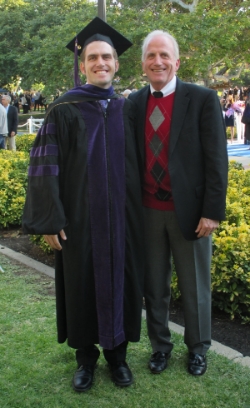
Yesterday I sat with my family and watched as my son and his wife shared such a moment for themselves. They have been a couple since they were 16 and have been married for three years. For all of those three years he has been in law school at UCLA, balancing the demands of a challenging course load and a brutal commute with his commitments to his family. It was a long and difficult journey but they completed it together.

As I watched him hug his wife, I realized that Lisa and I were completing a journey as well. We had made a promise to God, our family, our church and to one another to do our best to raise our son to be a godly man. Standing before us was such a man. The little boy that I once, in amazement, held in my arms, had just achieved his greatest goal with the woman he loved at his side. It doesn’t seem real.

Me and Nate, May 15, 2015

Me and Nate, May 15, 2015

What I am most proud of is not the degree he earned or the honors he received. He worked hard not for accolades and recognition but out of a desire to do good, to provide for his family and to honor his God. The people in his life and the God he serves are far more important than the diploma in his hand.

My prayer for my son is that he will continue to serve the God who has sustained us and loved us, the one who has given more than we could imagine and hope for and who has allowed us to realize so many of our dreams.

- Bart